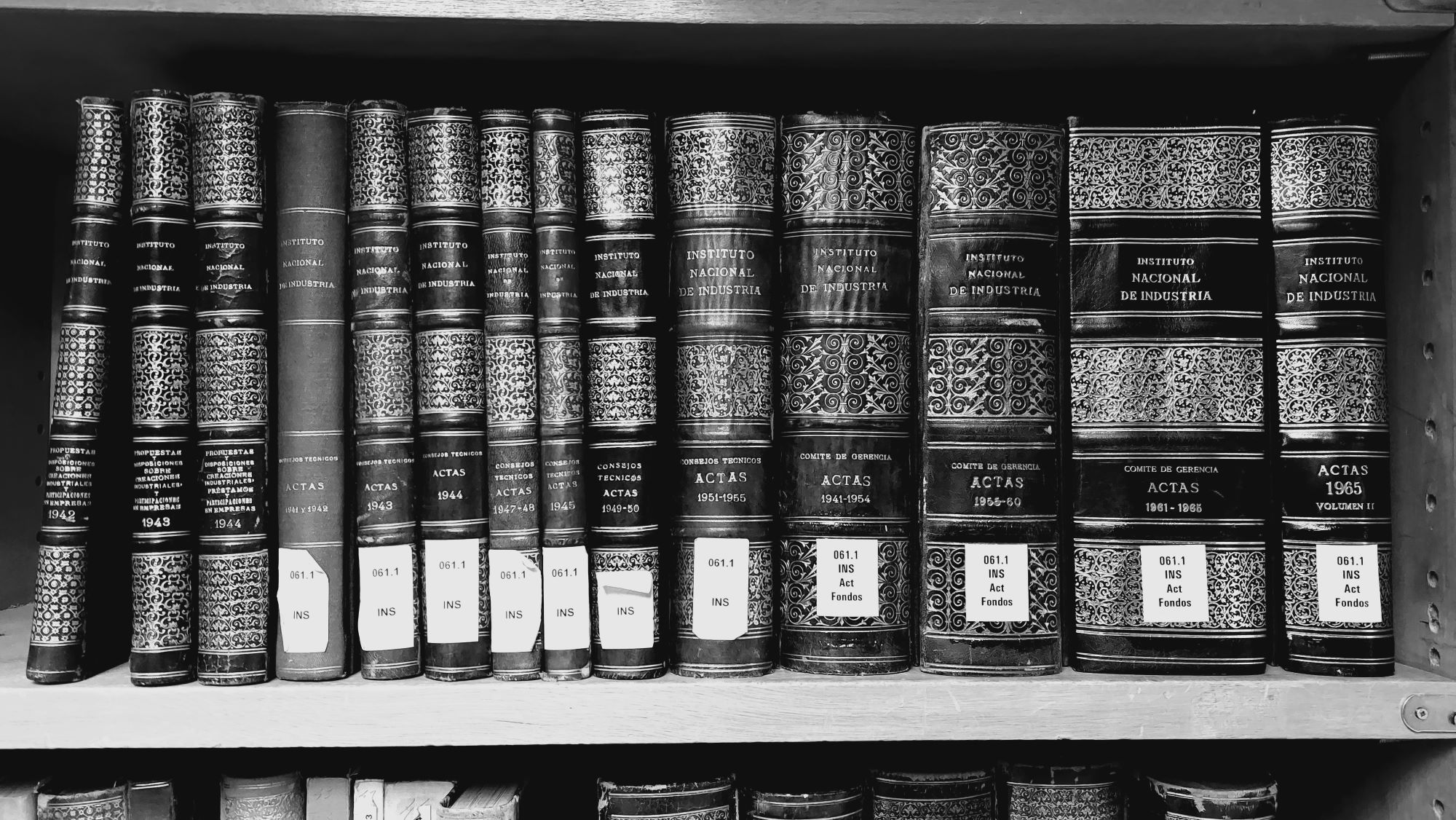
Descripción
The Historical Archive is made up by the collections from Instituto Nacional de Industria (INI), TENEO, Agencia Industrial del Estado (AIE), Sociedad Estatal de Participaciones Patrimoniales (SEPPA) and Sociedad Estatal de Participaciones Industriales (SEPI).
The archives of the companies which were attached to each of the above-mentioned institutions are not kept, but only the documents which were generated and exchanged during the implementation of the activities which were given to them. The documentation available to researchers is that generated by INI’s sections. The consult of the documents is authorized if the description and assessment procedures have been concluded.
Documentation available for consult
Denomination | Time range |
|---|---|
1941–1989 | |
1939–1979 | |
1942–1995 | |
1941–1995 | |
1943–1994 | |
6.1. José Sirvent | 1950–1968 |
6.2. Joaquín Planell Riera | 1938–1957 |
6.3. Julio Calleja | 1966–1970 |
6.4. Different chairmen | 1970–1990 |
7.1. Photographs collection | 1944–1988 |
7.2. Film collection | 1950–1980 |
1916–1978 |
Department of the Registro General del INI (1941–1989) ↑ Back to the table
Most of the documents produced and received were kept at the General Register, the department in charge of the distribution and the filing of the incoming, outgoing, or processed documents in INI.
The documents preserved at the General Register reflects INI’s activity, from its internal organization as an institution, to the industrial sectors which were of interest or on which invested, the financial situation and evolution, technical projects, minutes, laws, etc. of the companies into which the Instituto had a shareholding.
Decimal classification of INI’s General Register
The procedure used for its classification consisted in including the documentation into time-based records based on a decimal classification which attached a numerical code to each subject (nomenclator). Such an organizational system required the inclusion of several copies of each document on different classifications, which explains why it is usual to find several copies of a document in different sections of the Historical Archive.
The numerical codes of this classification were organized along a hierarchical criterium, from the general to the concrete, which reflects the Instituto’s organization and activities.
The following divisions were setup:
0 Section – General matters
When the document could not be classified by its thematic in any of the remaining sections or was regarded as an administrative issue of little importance without further processing, it was included in this section.
It preserves 18,829 records containing information regarding companies not belonging to INI, including commercial offers, supplies to INI or to its companies, institutions or particulars who were at some time connected with the Institute, laws which affected INI and its companies, internal administration, maintenance, buildings, purchases, services, exhibits, tributes conferences, reports, calls, trips, requests, and incidences of INI’s workers, etc.
1st Section – Accounting and finance
In this section was filed INI’s financing and accounting. It includes the correspondence with banks and financial institutions, budgets, loans, credits, donations, taxes, inventories, assessments, and insurance. It preserves 1,361 records.
2nd Section – Industrial section
A total of 2,223 records are preserved, which correspond to the different industries on which INI was interested, as well as those issues which affected several INI’s companies belonging to the same industry. This section includes, for instance, requests of aid for industrial projects, reports on the profitability of new investments, reports on industrial sectors and on companies not belonging to INI, investment projects, technical collaborations with private companies, both Spanish and international ones, procedures for purchases, offers to private companies for collaborating with INI companies, letters from private companies requesting financial support for new activities or for maintaining their activities, among other issues.
3rd Section – Companies
In this section 21,002 records are kept, and here were classified those matters which affected each company. It was required that the “Technical Consultive Councils”, whose functions were defined in the Founding Law, issued a previous report for analyzing the industrial section in which the company would be incorporated and for being able to propose to the Board of Directors and to the Government the new investment projects.
The documentation about the companies to be incorporated, either by the initiative of INI or at the request of the Government was filed in the subsection “Empresas INI en formación”.
Once the company was incorporated, a permanent numerical code was attached to it, which in turn was organized into the following nine sections: 0. Sundry; 1. Personnel; 2. Deeds, Byelaws, Rules; 3. Economics and Finance; 4. Studies, Reports and Technical Projects; 5. Law; 6. Affiliated Companies; 7. Minutes; 8. Confidential; 9. Orders.
4th Section – Orgánica del INI
This includes the rules, organization, rights, duties, etc. which were issued by INI’s departments and by their attached entities. There are 148 records left.
"Original files" or "Unique files" (1939–1979) ↑ Back to the table
The subsection called "Expedientes originales" (original files) or "Expedientes únicos" (unique files), was made up by express indication of the Chairmanship or the Management, with the original documentation of issues regarded as important or of a confidential nature, the reason of being decided that they should be kept independently from the others at the Fondo de Registro General. It makes possible to gain access to the complete file on a subject. It is made up by 1,119 files, and include documents from 1944 to 1970, with different issues linked to the activities carried out by the Instituto and by its companies.
Cash department (1942–1995) ↑ Back to the table
This department contains original documents of contracts, agreements, deeds, policies, etc., organized by the name of the company or entity, and which were filed individually with the aim of facilitating the location of the original document, extracting them from proceeding files of each matter and from the habitual placing of the originals in the General Register.
Vice Secretary of the Board of Directors (1941–1995) ↑ Back to the table
The documentation preserved in this section corresponds to the files generated by INI, TENEO and AIE’ governing bodies: It is organized into two subsections:
- INI subsection; made up by the documentation generated by those companies which were privatized or liquidated by 1995, the year in which INI disappeared, and INI’s own documentation.
- SEPI subsection; it is composed by the documentation from all the remaining companies which once belonged to INI and which later were transferred to TÉNEO or to the AIE and which finally were organically attached to SEPI, as well as TÉNEO’s and AIE’s documentation.
Series
It is made up by the following series:
Authorization files
Files generated by the collegiate bodies authorizing the transactions carried out by the affiliated companies.
Standing Committee files
Files generated by this companies’ controlling body, established in 1946, without a calendar for its meetings and, since 1986, once every year.
Minutes of the affiliated companies
Minutes of the Board of Directors and of the companies’ ordinary and extraordinary General Meetings of Shareholders.
INI Minutes
Original minutes of the Board of Directors, the Management Committee, the Management Board, the Executive Committee, the Executive Committee for Transactions, the Strategic Executive Committee, the Financial Committee, the Financial Subcommittee and INI’s Trade Subcommittee.
Minutes of the Technical Boards
Minutes of the Technical Boards, in charge of studying the industrial activities to be carried out by the Instituto (1943/1967)
Tools for information quests
This documentation has supporting tools for information quests, among which stand out the following:
- Summaries of the norms and legislation which had a bearing on the Instituto’s companies. (1943/1967)
- Summaries of the minutes of the Boards of Directors and the General Meetings of INI’s companies (1945/1970).
- Industrial incorporations and shareholdings in companies: Proposals of the Instituto and official dispositions. (1942/1947).
- Indexes of the minutes of INI’s Board of Directors (1947/1977).
INI departments (1943–1994) ↑ Back to the table
As a result of the Instituto’s internal reorganizations, the archives of the departments either were transferred to other administrative units or eliminated, due to the changes along time in the organizational chart. Documentation has been preserved regarding the following administrative units:
- Real estate department
- Building department
- Economic and Financial Services department
- Transformation department
- Steel, metallurgical, and mining department
- Technical department
- Department for General Issues
- Department for Social and Cultural Issues
- Photography and microfilm department
The usual way of distribution which was established was the copy of the documents which was registered in order to facilitate its access to the processing departments and, as is the case in other collections, it is possible to find duplicated documents in the Register, together with technical and managerial documents of the functions attached to each administrative unit, which in many cases were not registered and which supplement the analysis of the companies’ activities and projects. 813 records have been described, and the inventory of this collection continues.
Chairmen and other senior managers (1938–1990) ↑ Back to the table
This collection of documents is mostly made up by the documents about the chairmen’s management. The Institute was organized along presidential lines, and thus the decisions taken by each chairman determined the route taken by the state-owned group, always with the Government’s authorization.
Although this grouping includes recorded documents, it basically keeps issues regarding exclusively the managers activity, thus making it possible to follow up the issues led by each chairman during his term of office.
The documents managed by the following senior managers can be accessed:
- Chairmen: Mr. José Sirvent Dargent, Mr. Julio Calleja y González Camino, Mr. Claudio Boada Vilallonga, Mr. Francisco Fernández Ordóñez, Mr. José María Guerra Zunzunegui, Mr. Juan Miguel Antoñanzas Pérez-Égea, Mr. Francisco Jiménez Torres, Mr. José Miguel de la Rica Basagoiti, Mr. Carlos Bustelo y García del Real, Mr. Enrique Moya Francés, Mr. Luis Carlos Croissier, Mr. Claudio Aranzadi Martínez, Mr. Jorge Mercader Miró and Mr. Javier Salas Collantes.
- Vice President: Mr. Joaquín Planell Riera.
The information about the chairmen can be accessed through the files describing each of them.
Audiovisual collection ↑ Back to the table
The control exercised by INI regarding its companies’ activities and results, as well as the obligation of informing the Government resulted in the idea of collecting photos and films as tools for divulgation and propaganda.
The audiovisual collections are made up by different collections:
- Photographic collection
- Collection of film negatives
- Slides collection
- Collection of film positives (black and white and color)
- Films collection
- Collection of photochemical materials (image and sound negatives, copies, on 16 and 35 mm, black and white and color)
- Video collection (VHS, U-Matic, Beta Cam)
Reproduction of the Juan Antonio Suanzes Fernández Collection ↑ Back to the table
This documentation belongs to a personal collection generated by INI’s first chairman. Thanks to an agreement reached with the Suanzes family, the documents were digitalized and described, depositing a digital copy at SEPI’s Documentation Center and Historical Archive, while the originals are kept at the Real Academia de la Historia.
It includes documents from 1916 to 1978, and thus some of the documents belong to a time before and after his INI chairmanship.
This collection is a must for knowing about the first decades of INI and its companies, as well as about Spain’s industrialization.
You can have information about this chairman accessing his descriptive file.
Frequently asked questions
Below are several questions which have arisen about the Historical Archive and its documents, with the goal that the users can obtain a better knowledge about the documents, the operation and the services provided.
What are the opening hours of the Historical Archive?
October to May: Monday to Thursday from 9:00 a.m. to 2:00 p.m. and from 3:00 p.m. to 5:00 p.m.; Friday from 9:00 a.m. to 2:00 p.m.June to September: Monday to Friday from 8:30 a.m. to 2:30 p.m. Closed in August
Is it necessary to travel to Madrid to consult documents?
Yes. Consultation of the documentation must be carried out at the premises of the SEPI Historical Archive, except in cases where the document has been digitized and is publicly available on the Archive’s website.
What can be consulted at the Historical Archive?
Files and documents from the collection of the National Institute of Industry (INI), as well as accessible collections of photographs and films produced or gathered by the INI, the Library, and the Historical Newspaper Archive. Researchers will have free access to all documents that meet the legal administrative requirements and deadlines for consultation.
How can I search for documents and files on the website?
The search function is available through the “Search” option on the website. The documentation held by the Historical Archive has not been digitized, so currently only indexes with references to the documents preserved in each volume of the different sections are available. Searches can be performed using simple queries that allow free-text input and return results in chronological order. Documentary operators described in the help icon can be used to make more specific searches. It is recommended to review the description of the archive’s collections beforehand to choose appropriate keywords.
How can I contact the Archive if I can’t find what I’m looking for in the database?
You can contact the Historical Archive by email at archivo@sepi.es , indicating the research topic and the documentation you wish to consult, or by filling out the “Queries and Suggestions” form.
Is it necessary to book an appointment to carry out a consultation?
Yes. Consultation of the collections requires an appointment since the storage facility is located outside SEPI’s main headquarters.
Do I need a researcher identification card to access the reading room?
No, it is not necessary to have any type of card to access the consultation of the Historical Archive, Library, or Historical Newspaper Archive collections. Access is free of charge; you only need to present an identification document (ID card, passport, NIE, etc.).
Does the Historical Archive keep all existing documentation on public companies?
No. The Historical Archive preserves the collections produced through institutional relations with public companies under INI, TENEO, AIE, or SEPPA
Does the Historical Archive hold the records of public companies that depended on INI, TENEO, AIE, or SEPPA?
No. The Historical Archive only preserves the records of the parent institutions. The documentation reflects their internal organization and, through control systems over the companies, contains the technical, economic, and legal information required from them.
Can all documents in the Historical Archive be consulted by interested individuals?
Some documentation has restricted access, according to current legislation, because it contains data affecting the security and defense of the State, criminal investigations, or personal privacy.Access is also restricted to documentation that presents conservation problems or could be damaged by handling (e.g., maps and plans attached to reports). Likewise, documents undergoing technical processing and description are not available for consultation.
Can books and journals be consulted at the Historical Archive?
Yes. The SEPI Library and Newspaper Archive, which include the former INI Library and Newspaper Archive, are accessible by request to researchers and serve as research material and support resources.
Is there Internet access in the reading room?
Yes. There is a computer available for consultation with limited Internet access. Users may also connect to the Internet using the available Wi-Fi network and their own personal devices.
Can copies of documents kept in the Historical Archive be obtained?
Upon request, researchers may use their own devices (compact cameras, mobile phones, tablets) to reproduce documents of interest, provided that the documentation does not have conservation issues or legal restrictions. The use of flash, lighting systems, scanners, or any equipment that comes into contact with the document is not permitted. Photocopying services are not available.
How can the images taken be used?
Images captured by researchers during their consultation may be used only for private, teaching, or personal research purposes. Any commercial use, distribution, public communication, or transformation of the images in any form requires explicit authorization from SEPI.
Do the staff of the Historical Archive carry out research?
No. Users themselves must access the Historical Archive website to perform preliminary searches and visit the facilities to consult relevant documents. If necessary, Archive staff may provide guidance on search strategies.
Are the Historical Archive facilities accessible to people with disabilities?
Yes, the facilities of the Historical Archive are accessible.
What type of office supplies may I use in the Historical Archive?
During the consultation of documents, only pencil and paper may be used for taking notes or transcribing documents. Personal laptops are also allowed. Pens, fountain pens, and similar items are not allowed due to the risk they pose to documents. Sharp objects are also prohibited. Bookmarks are available for marking pages during research, but they must be removed at the end of the consultation.
How much documentation can be consulted per request?
Up to a maximum of 25 storage units.
Is it possible to borrow documents?
No. The Archive does not offer a loan service.
Can requested documents be reserved for future visits?
If you finish your visit to the Archive without completing the consultation of the requested materials, you may inform the Archive staff, who will indicate whether it is possible to reserve them for a future appointment depending on space availability.
The register regulations
The consultation of the documents will take place in accordance with the regulations included in "Regulation for accessing and consulting documents at the Archivo Histórico SEPI".